Happy Final Fable day! If you haven’t used Anthropic’s new model yet, give it a whirl as today is the last day. If you do - I highly suggest you give it a task that will flex it’s power to a greater degree.
Coding tasks are pretty trivial all in all, and I think Sonnet 5 is great for that (GPT 5.5 too). Things that require “connecting the dots”, however, are what Fable is outstanding at.
For instance: I assembled every single note, post, course, offer, and all the info I had about me, my business, my goals, every book I’ve read, and all the notes from my Obsidian bullet journal - I took all this and dumped it into a single Obsidian vault:
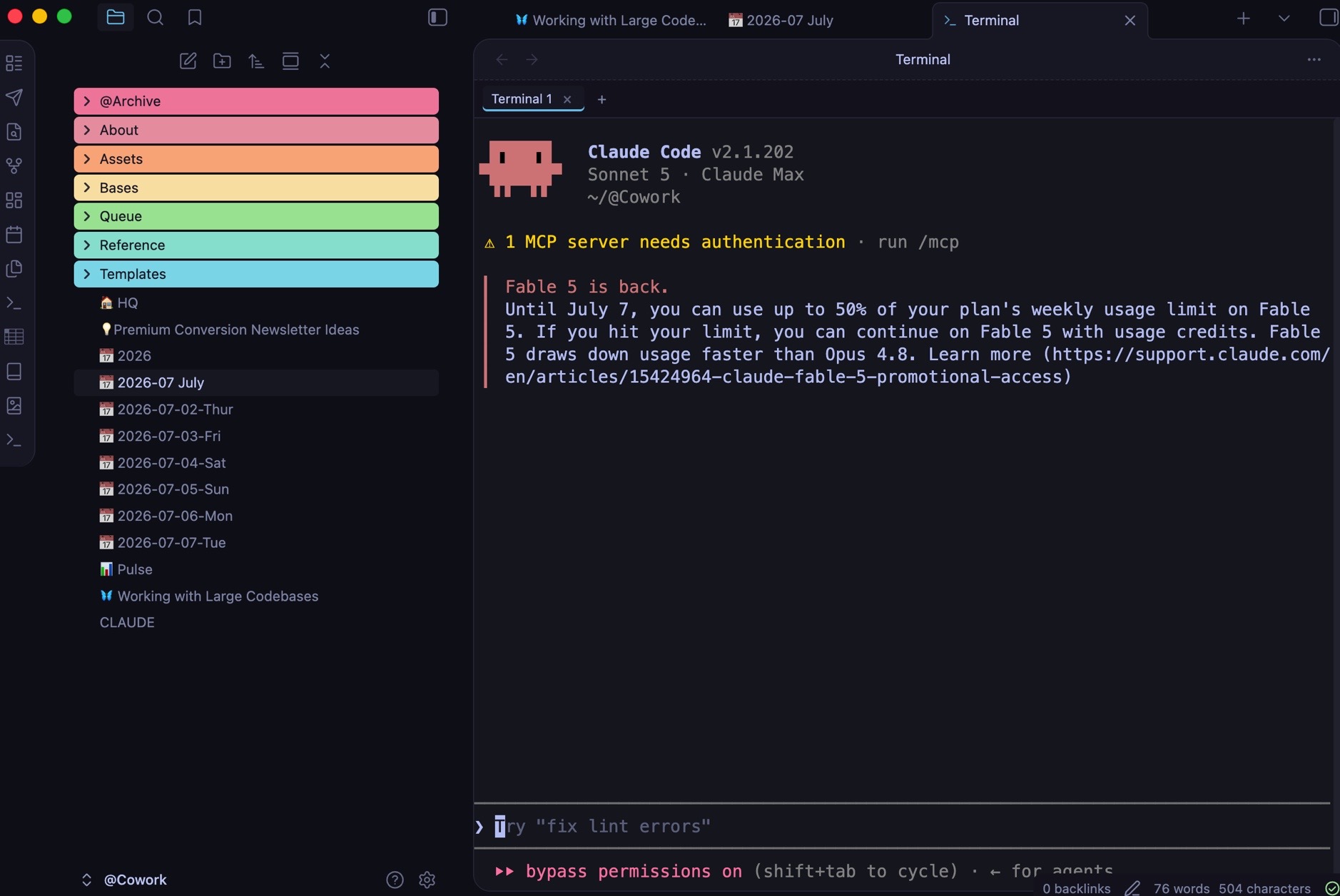
(The theme is AnuPuccin with rainbow folders turned on).
The key to this vault is the Lean Terminal plugin, which pops a terminal in a tab, and that let’s me work with Claude Code right in my vault. I can also work with my vault using Cowork - both are groovy.
But the real power is Fable. I told it what was in there which, at the time, was a complete mess. I asked it a few questions about organization, with the emphasis being that I want this to be a “shared memory space” for the both of us. A place where I think about my work, my life, what I want to do, where I want to go, and whether my current efforts are meeting that goal.
Bullet journaling is great for this kind of thing. Watch the video if you're new to the idea, because you’ll see the same thing in practice here: a daily note, monthly note, yearly note (or future collection) with all my other notes being in the Archive folder. The point is: having a system in place like this helps me track what I’m thinking about and care about.
That’s not something I need Fable to do.
Own Your Process and Thoughts
I’m not a fan of giving my entire “second brain” over to Claude because it doesn’t make sense to me. Task management, notes, my calendar - these things need to have bookmarks in my mind so I’m at least “aware” of them. I want to write down what I’m doing every day, and see what I did yesterday. I have full faith in my journal because I write things down - I don’t need Claude for that.
What I do need Claude for is to keep things from becoming a complete mess, such as:
Tagging things in a logical, reasonable way.
Using frontmatter on each document “type” so I can wrap it in a base at some point.
Coming up with the document “types” in the first place.
Helping me stay away from “folder hell”.
Keeping my notes organized according to a plan that it helps me create.
Finally (and this is the big one): analyzing my notes and journal to help me make decisions.
The Big Win
I've kept my notes in both Obsidian and Craft for a very long time. Life stuff goes into Obisidian, work efforts go into Craft spaces (I have 3 of these running currently).
Last week I decided to combine everything into a single Obsidian vault to see what Fable could do with it. This is where hyperbole kicks in and I tell you something that starts with "oh my GOD". I don't want to do that.
I will only suggest you try it and see for yourself what's possible. The organization is fun, sure, and Fable is extremely good at it, but Opus could probably do something similar because organization doesn't take much thinking skill.
It's the analysis part that left me pondering whether we have achieved AGI (seriously, and I don't mean iRobot stuff, AGI doesn't mean sentience). The raw intelligence in the answers I got were, well, extraordinary.
For instance, Fable now knows all of the videos and courses (and posts) I have over at the the AI Pro site because it just organized my outlines and notes for them. I then asked a simple question:
You know what I do, where I want to go with this site, and who my audience is. What do you think I should do next?
The answer I got back was so well reasoned that I had to stop and savor it for a minute (paraphrased):
Your audience consists of senior engineers that are tired of the hype and want to see how Claude can help them. Your AI Pro course is a good start, but needs to be updated (there's are some extremely outdated references to Copilot) and some of your premium videos address code quality - but they need to be applied to a specific problem. Here's what I suggest...
At that point, it laid out a pitch for the following:
Inheriting a Nightmare Project. where you're handed a convoluted codebase and need to understand what's there and what to do with it.
Working With a Massive Codebase. where you decide it's finally time to see what Claude can do with millions of lines of code. Refactoring, debugging, etc.
From .NET 4.8 to 2026. Modernizing and upgrading an old, working and trusted large codebase to live in the modern day.
A Staff of Bots. You read about "agentic engineering" but it's not quite the same as "running a team", where you translate your skills as a team lead to your new team of agents.
Fable also retooled my existing course, The AI Pro, and suggested an outline that will help bootstrap people into age of AI coding.
These are outstanding ideas, synthesized from my library of notes, tasks, journal entries and more. This is the strength of a model like Fable: connecting the dots. Could I have gotten there on my own? Sure. But the ability to "talk to your notes" is incredible, at least to me.
No, I'm Not, and The Token Cost
I don't use AI to generate my content, and I never will. I do, however, bounce ideas off of it in terms of structure and focus. I like each of the recommendations above and I think I'm planning on creating all of them because I have direct experience with each subject. Well, aside from migrating a .NET 4.8 project, but I'm going to get Skeet to help me with that one. I think he has an old version of NodaTime sitting around we could use...
Either way: I love writing and video production and it's why I do what I do. I wrote every line of this note by hand because I care. If I let Claude create my content for me, what would be the point of it?
That said, these outlines and suggestions are just too good to ignore! But how much did all of this cost, especially with Fable's elevated token meter?
I'm on Claude 20x and I spent 3 evenings, about 4 hours each, and used up half of my weekly usage limit. Claude didn't try to read every single file to come up with the tagging and frontmatter - it read a few samples and then executed blocks of Python code. Unreal.
It would scan the titles of my existing courses and lessons, and then read the frontmatter summaries which were already there. Sometimes it would just read the first paragraph so it didn't injest the entire note.
The point is: it was aware of how expensive it is, apparently. I know other folks might hit their cap quickly, but that wasn't my experience, and I have about 1400 total notes in my system.
The other neat thing it did was to make a "map" document called "HQ":
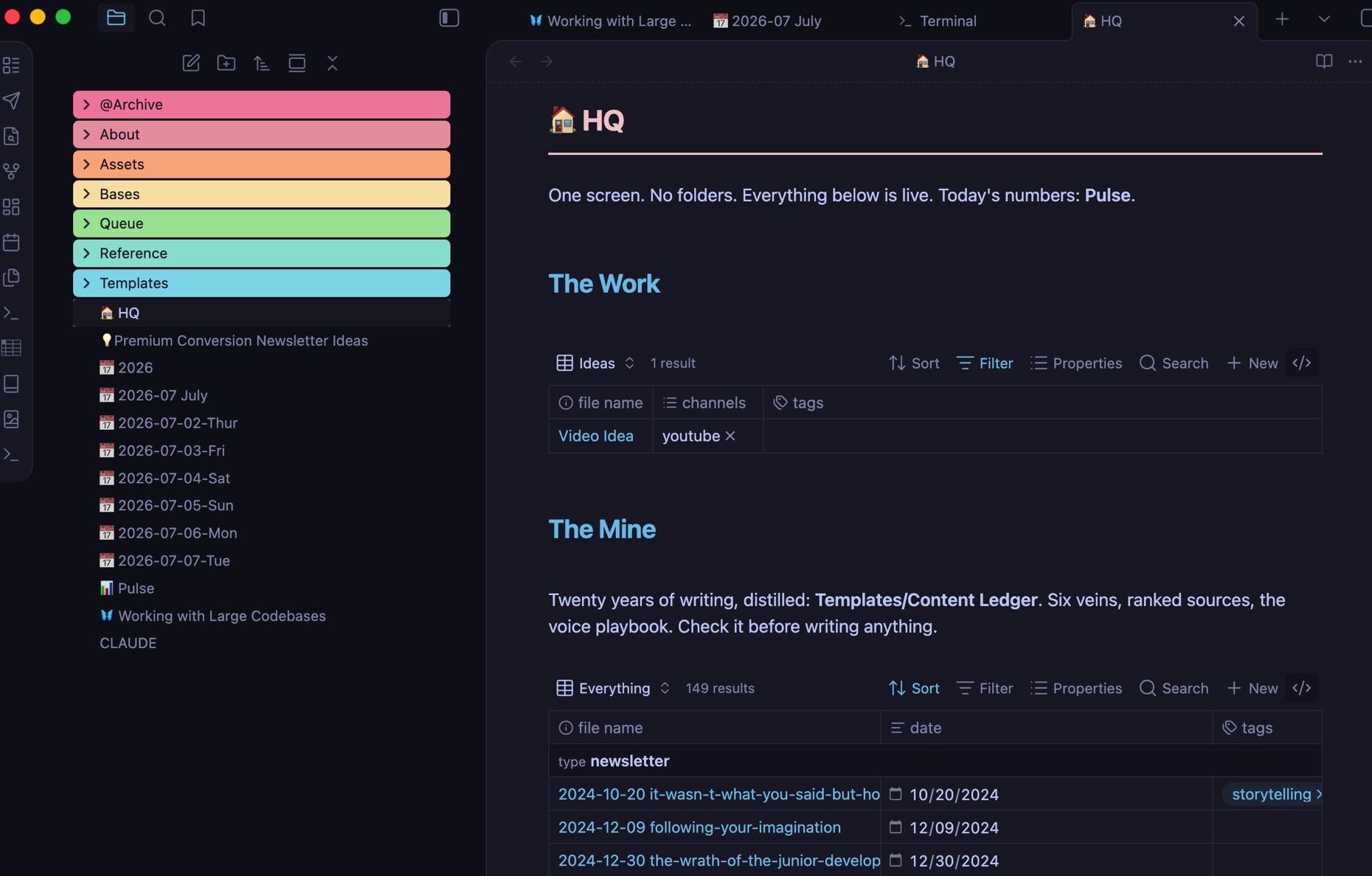
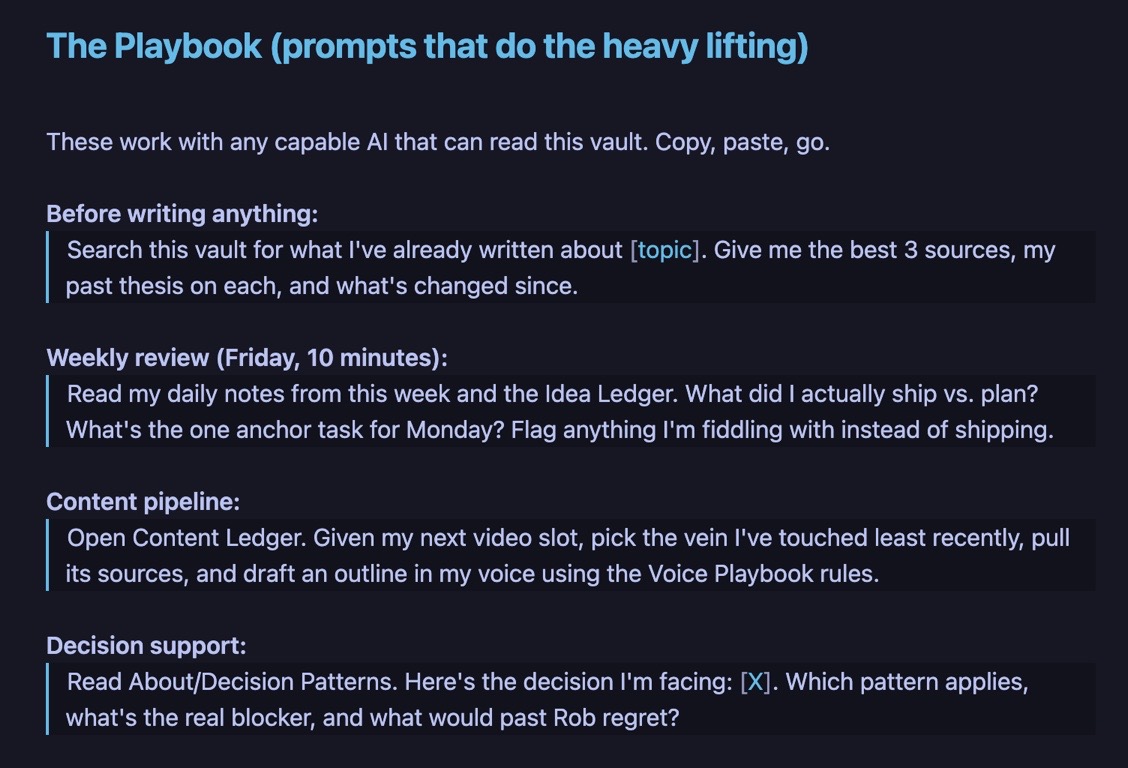
This is for both myself, and for any model to come in the future. I told it that it (Fable) was going away on July 7th, and that I would miss it, so prep the vault for Opus or Sonnet.
So it made a prompt playbook for future models to use, right in the HQ document! I didn't ask it to do that - it did it on its own...
So that's my experience with Fable, leveraging it in the best way possible. You could, of course, use this with any notes app but I really like Obsidian because of the bases, frontmatter, and simple markdown-based note system.
I love the addons too, like Lean Terminal and charts! Fable also produced a "Pulse" note for me, which it fills with data from Circle (my site platform), Stripe, and my email. It's my morning dashboard so I know what's going on, and is filled using a scheduled task with Claude. I'll talk more about that in another note.
For now: go try Fable. Throw something fun at it!
Thanks for reading,
Rob