Team training · 3 weeks · on your codebase
Your team has the seats. Now get the leverage.
You bought Claude Code (or Cursor, or Copilot) for the whole team months ago. A few of your engineers are doing great work with it and the rest are using it as a slightly better autocomplete.
Leverage for Teams is the cohort I run for senior programmers, run privately for your team, on your codebase, over three weeks.
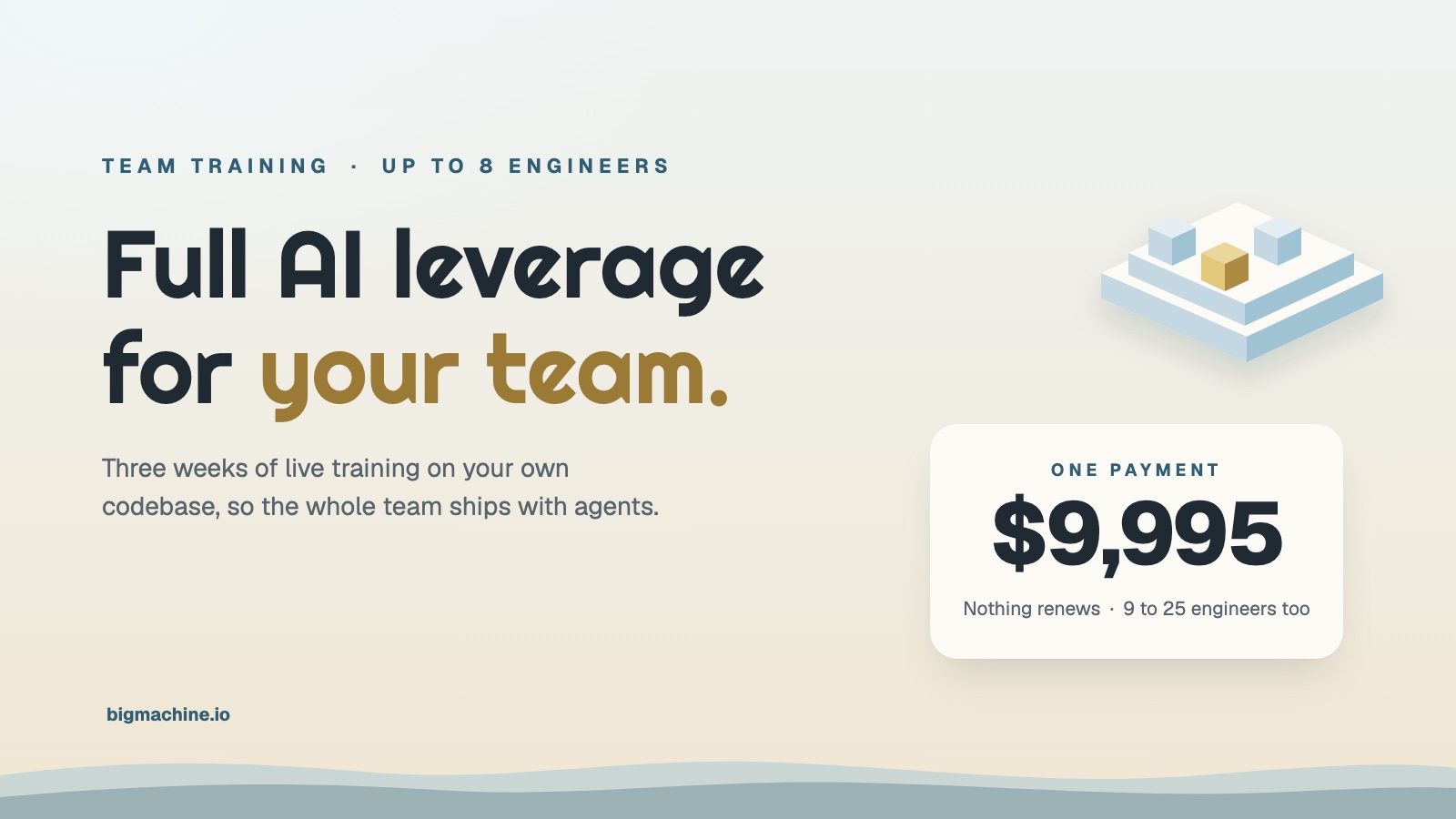
one payment · $9,995 for up to 8 engineers · bigger teams below
01 · Where most teams are
The seats are bought. The work hasn't changed.
Most teams I talk to are in the same spot. The company paid for AI seats for everyone, there was a kickoff and a Slack channel, and six months later two or three engineers are doing remarkable things with agents while everyone else tabs through suggestions. I did exactly that for longer than I want to admit.
Your engineers are good, so this isn't about skill. Nothing is shared. Everyone has their own prompts, their own habits and their own idea of how far to trust the thing, so what comes out depends on who was driving that day.
02 · What that costs
And it adds up.
Pull requests nobody can review
One sprint of my own project came back from the agents as a 6,000 line pull request. Could you review that? Could anyone on your team?
Debt, faster than before
Agents write code quicker than anyone can read it. Without rules they have to follow, the mess piles up faster than it ever did by hand.
Two people become the bottleneck
The engineers who get it end up reviewing, fixing and explaining for everyone else, and their own work stops.
Nothing to show for the spend
The seats cost real money every month. When your boss asks what the team got for it, a couple of good demos is a thin answer.
03 · What this is
The cohort, run just for your team.
I've run three cohorts for senior programmers this year, and the Fall one had a theme: leverage. For most of my career the things I wanted to build got cut because coding takes time and there was never enough of it. That's changed, and the people in that room spent three weeks finding out how much.
Leverage for Teams is that same cohort, run privately for your team, on your codebase and your backlog. Two live sessions a week and office hours on Friday, for three weeks.
We don't vibe code here. Your team builds its own skills, its own rules and its own process, the kind an agent has to follow, and by the end of week three you've shipped something real with all of it.
04 · What the team builds
By the end, this is in your repo.
None of this is a slide deck. Each one is a file, a hook or a workflow that your team writes during the sessions and keeps using after I'm gone.
A product designer skill
A skill that reads every spec before any code gets written and pushes back until the customer would love it. Mine is named Steve. Yours gets its own name.
House rules and an anti-debt skill
Your standards, your testing style and the things you never want to see in a PR again, written down once so every session starts with them loaded.
A shared CLAUDE.md
One file for the repo that the whole team works from, so the agent behaves the same way no matter who is driving.
Hooks and verification gates
You can't make a model deterministic, but you can check its work every single time. Scripts, git hooks and Claude Code hooks, wired in and tested.
GitHub as the plan of record
Epics, sub-issues and a board the agents work from, so anyone on the team can see what's being built and why.
A review process that holds up
How to review what agents write, with a Claude first pass in CI, so your people spend their time on the parts that need a person.
05 · The schedule
Three weeks, on your calendar.
Monday and Wednesday are live sessions, 90 minutes each. Friday is office hours, where people bring what they're stuck on. It's the same schedule the Fall cohort ran on.
We pick the three weeks together, and the times are set for your team's timezone. Every session is recorded and transcribed for the people who miss one.
- Week 1 · MondayThe bet and the harnessEach engineer names the part of the job they most want to hand off. We look at why the system prompt is the real tool, and the team builds its product designer skill.
- Week 1 · WednesdaySkills that keep the crap outHouse rules, an anti-debt skill, your testing style and user stories, written from the standards your team already has. Plus the shared CLAUDE.md.
- Week 1 · Friday · office hoursBring the thing that brokeEveryone brings what fought back this week. We fix the rule or the skill, and the fix goes into the shared set.
- Week 2 · MondaySprinkle in some determinismOrchestration from your real backlog. GitHub as the plan of record, hooks, and gates that check the agent's work every time.
- Week 2 · WednesdayHarnesses and reviewWho owns the system prompt in each tool, picking one tool as a team, and how to review a very large agent PR without losing a day to it.
- Week 2 · Friday · office hoursShow and tellPeople show what they built with the new setup, what worked and what they changed.
- Week 3 · MondayThe idea councilThe features that keep getting cut go to a council of agents that challenges each one. The team votes, and agents build three prototypes of the winner.
- Week 3 · WednesdayShip itSkills before code, orchestration with reviews and tests, and a deploy to staging or production. We finish with a 30 day plan.
- Week 3 · Friday · office hoursEvery feature liveDemos from the team, the wrap-up, and the before and after report for you.
06 · Week three
The session people talk about afterwards.
On the Monday of week three your team brings the ideas that never make it onto the roadmap, one paragraph each. Each one goes to a council of agents that researches it and argues about whether it deserves to live. The team votes on the survivors, and then agents build three working prototypes of the winner while everyone makes the calls: what to cut, what to try next.
In the Fall cohort this was the best session of the three weeks. There were great ideas, working prototypes and a lot of laughing. One idea went from a paragraph on Monday to a live site with its own domain on Wednesday. Someone else rebuilt a 15 year old site in two hours.
Your team does the same thing, with your backlog.
07 · What you keep
It's all yours when we're done.
The skills repo
Every skill, rule and hook the team wrote, in your own repository, ready for the next project.
The recordings
All nine sessions, recorded and transcribed, private to your team. New hires can watch them.
The AI Pro, for everyone
My full course on working with AI, for every engineer on the team, to fill in whatever the sessions didn't reach.
A report for your boss
A short before and after: what the team was doing in week one, what it's doing in week three, and what shipped.
08 · From the cohorts
What people did with it at work.
There is no doubt that Rob’s cohort has changed the way I work in general and specifically the way I work with Claude Code. Rob has a rather unique pragmatic and outcome oriented approach to software development compared to some of the more dogmatic approaches found. I feel more in control of the process I use with Claude and have been able to align Claude with the way I need to work because of this course.
Just got home from work where we did an AI hackathon with the HR department. It was a big success and it made me realize what I’ve learned in the cohort. One thing that stood out was the process of interviewing, developing and verifying. It already is so normal for me to have Claude interview me. Guess what, not everyone is familiar with that process. The discussions and experiences from the cohort definitely made me prepared for the AI era!
Rob’s insatiable curiosity in balance with the practicalities of enterprise-grade solutions makes him perfectly qualified to lead adventures into the bleeding edge of technology. I thoroughly enjoyed my cohort and can’t wait to see what Rob produces next.
09 · Who runs it
Hi, I’m Rob.
I wrote The Imposter’s Handbook, spent three years on the VS Code team at Microsoft, and I’ve been shipping software for 25 years. I’ve been teaching programmers for most of that time, and this year I’ve run three cohorts on exactly this material.
I also run my own business with agents every day, about 25 of them at last count. One of them crawled into my production database and nearly truncated it, so I teach the failures too.
I run every session myself. You won't get handed to an associate.
10 · The price
Pick your team size.
One price for the team, by how many engineers are in the room. Everything on this page is included at every size. One payment, and nothing renews.
16 to 25 engineers
11 · Before you ask
The honest answers.
Can we pay by invoice or with a PO?
Yes. Email rob@bigmachine.io with your team size and I'll send an invoice. If procurement needs a form filled out, send that too.
Can I talk to you before we buy?
Of course. Email rob@bigmachine.io and we'll set up a call. I'd want to hear about your team before we start anyway.
When can we start?
We pick the three weeks together. Once you've booked I'll email you within a business day with the weeks I have open.
We use Cursor or Copilot, not Claude Code.
Most of what I show uses Claude Code because that's what I run every day. The skills, the rules and the process carry over, and Cursor and Copilot folks do fine in my cohorts.
Our code is private. How does that work?
Your team works in your own repo, on your own machines. I see what people share on screen during the sessions, and the recordings stay private to your team. If you need an NDA signed first, send it over.
What do you need from us?
A real repo and a real backlog, a paid AI coding tool for each engineer, and 90 minutes on Monday, Wednesday and Friday for three weeks. The work in between happens on things your team was going to build anyway.
We have more than 25 engineers.
Then we split into two groups so everyone still gets time in the room. Email rob@bigmachine.io and I'll put a quote together.
Is this a subscription?
No. One payment for the three weeks. Nothing renews and there is nothing to cancel later.
What happens after I pay?
Stripe hands you back to Big Machine with a receipt in your inbox. I email you within a business day to pick dates, and I'll ask for your engineers' email addresses so I can open The AI Pro for each of them.
Workshop · Checkout
Leverage for Teams, up to 8 engineers
One payment of $9,995. Nothing renews. I'll email you within a business day to pick your three weeks.
Bigger team? 9 to 15 engineers or 16 to 25 engineers.
$9,995One payment. Nothing renews.
What you get
- Six live sessions, 90 minutes each, Monday and Wednesday for three weeks
- Three Friday office hours, for whatever broke that week
- Everything done on your codebase, from your backlog
- Your team's skills, CLAUDE.md, hooks and review process, in your repo
- Every session recorded and transcribed, private to your team
- The AI Pro course for every engineer
- A before and after report you can hand to your boss
If the first week doesn't work for your team, tell me before the second week starts and I'll refund all of it. You keep whatever the team built.
There is no doubt that Rob’s cohort has changed the way I work in general and specifically the way I work with Claude Code. Rob has a rather unique pragmatic and outcome oriented approach to software development compared to some of the more dogmatic approaches found. I feel more in control of the process I use with Claude and have been able to align Claude with the way I need to work because of this course.
What happens next
- Pay right here, on this page.
- Stripe handles your card. This site never sees the number.
- You land back here with your access switched on and a receipt in your inbox.
Your order
Leverage for TeamsStripe handles your card. This site never sees the number.
The payment form didn't load, which is on me, not you. Refresh and try again, or email rob@bigmachine.io and I'll sort it out.
Not on sale right now.
You already have Premium. Core is an upgrade to the membership you have, not a second one, so there is nothing to buy here. Stripe works out the difference for the rest of your year.
Upgrade to CoreThree weeks, and your team ships differently.
Six live sessions, three office hours, all of it on your code.