
No one from Microsoft actually told me I was laid off. To this day, not a single human being said to me, point blank: "your time with Microsoft is at an end". The people I worked with were kind, of course, and Microsoft did a pretty reasonable job ending my career there. Good severance, support during transition, all of that.
Yet not one human being sat with me, face to face, and told me my job had ended. This is the world we now live in, and I have felt it's mechanical embrace.
I know this wasn't the intention. I received an invite at 4am for a meeting scheduled at 6am. I was, as you might have guessed, asleep. I was also laid off in my sleep, because the meeting happened without me there, and no one ever followed up with me, other than a cold email letting me know some security stuff no longer worked.
I live in Hawaii, and as global as Microsoft is, they have always seemed to forget that time zones exist in Hawaii. I would routinely have to be at 6am meetings and, at one point, my manager told me plainly that I needed to be on a 5am standup or else there might be "consequences". I suggested we have a call with HR to see what those consequences would be, and the manager never brought it up again.
I'm not here to dump on Microsoft. Yes, the layoff wasn't handled well, but it's a big company and I'm a big boy. The severance was generous and I've moved on, as have they. It's the tech industry, churn is what we do.
I'm not clear as to why I was laid off, however, as I was delivering the most impact of my tenure at the time. I was giving Copilot/Claude workshops to internal engineering teams, developing curriculum for both internal and external AI workshops, and creating some solid videos for the VS Code team. This was easily the peak of my time at Microsoft... and then it wasn't.
Somewhere an algorithm was run, and my name came out as a result. I don't know for certain, but I'm pretty sure that some type of LLM was involved as the layoffs, overall, seemed very targeted. It makes sense that Microsoft would do this; they're trying to model what AI efficiency looks like, which means you can "do more with less". That's a slogan we had to live with internally, and I think we all understood that it meant people, as well as resources.

When The Machine Decides
Did a machine decide my fate at Microsoft? Probably. It makes sense: I've seen what Claude can do. Especially nowadays. Put in the right hands (and this is key, and I'll come to this in a second), a well-run Claude Opus 4.6 agent can actually exceed what a meatspace person can do.
I can see the decision process clearly on this:
If we use AI to come up with the headcount reduction selection process, we're sidestepping a lot of legal ramifications. A terminated employee can't come back and say "I was targeted" because a human wasn't in the loop. It was a machine, so it's much more fair... and humane.
If you've worked in a large corporation you've probably witnessed backwards logic like this. There is a strange truth to it, if you Obi-wan your perspective, but ultimately I think we, as humans, need to understand that machines are about to rock our reality. Because we're letting them. We want them to.
I've seen it. I'm doing it. In fact, I'm enabling this very thing when I share what I'm learning publicly. I'll go even farther than this...
With Great Power
I have found myself not making a video on something I've done because it will, quite literally, get someone fired, somewhere.
For instance: right now I'm running an agent "swarm" in a console window right next to me. These little guys right here:
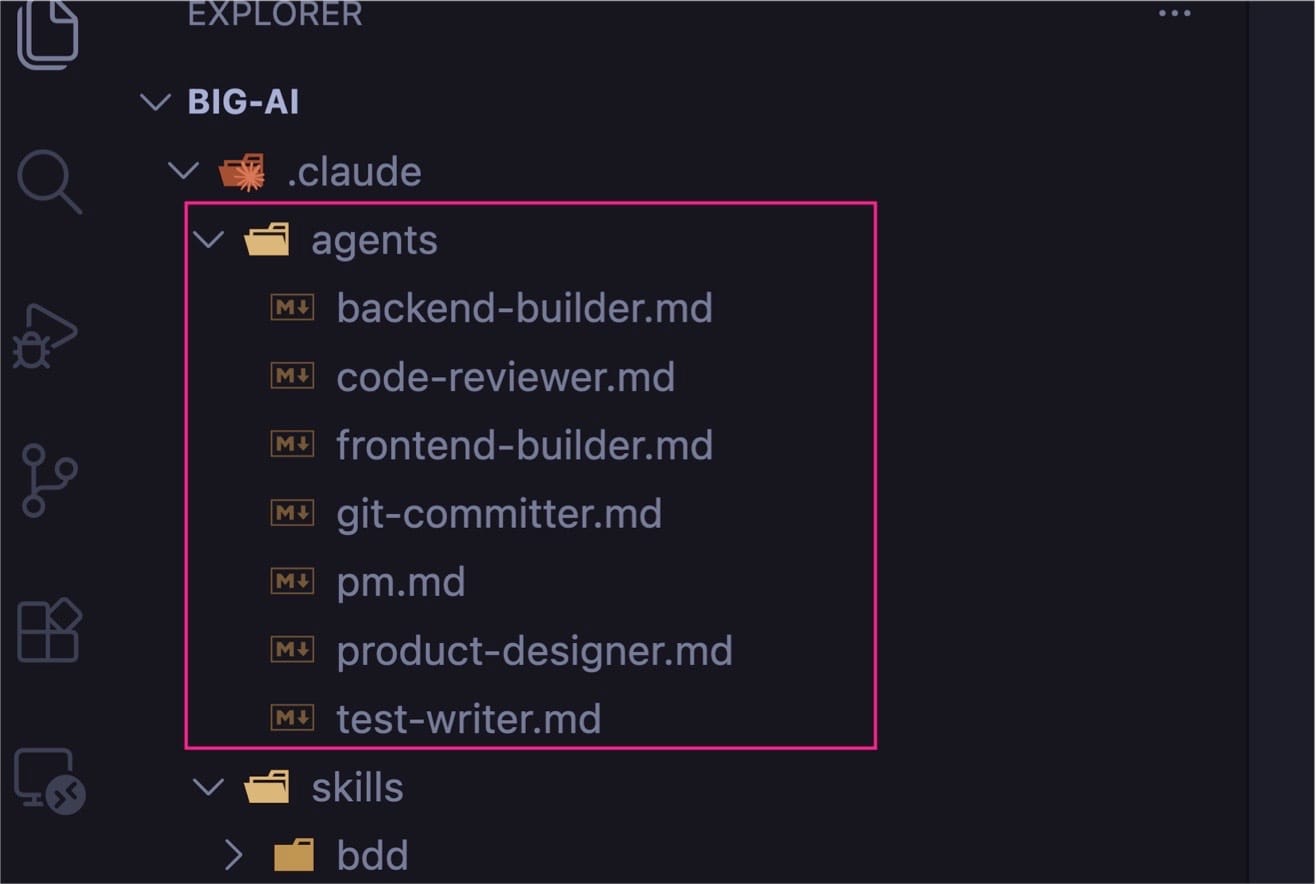
I have them running in an orchestrated loop, using a bash script that Claude made for me:
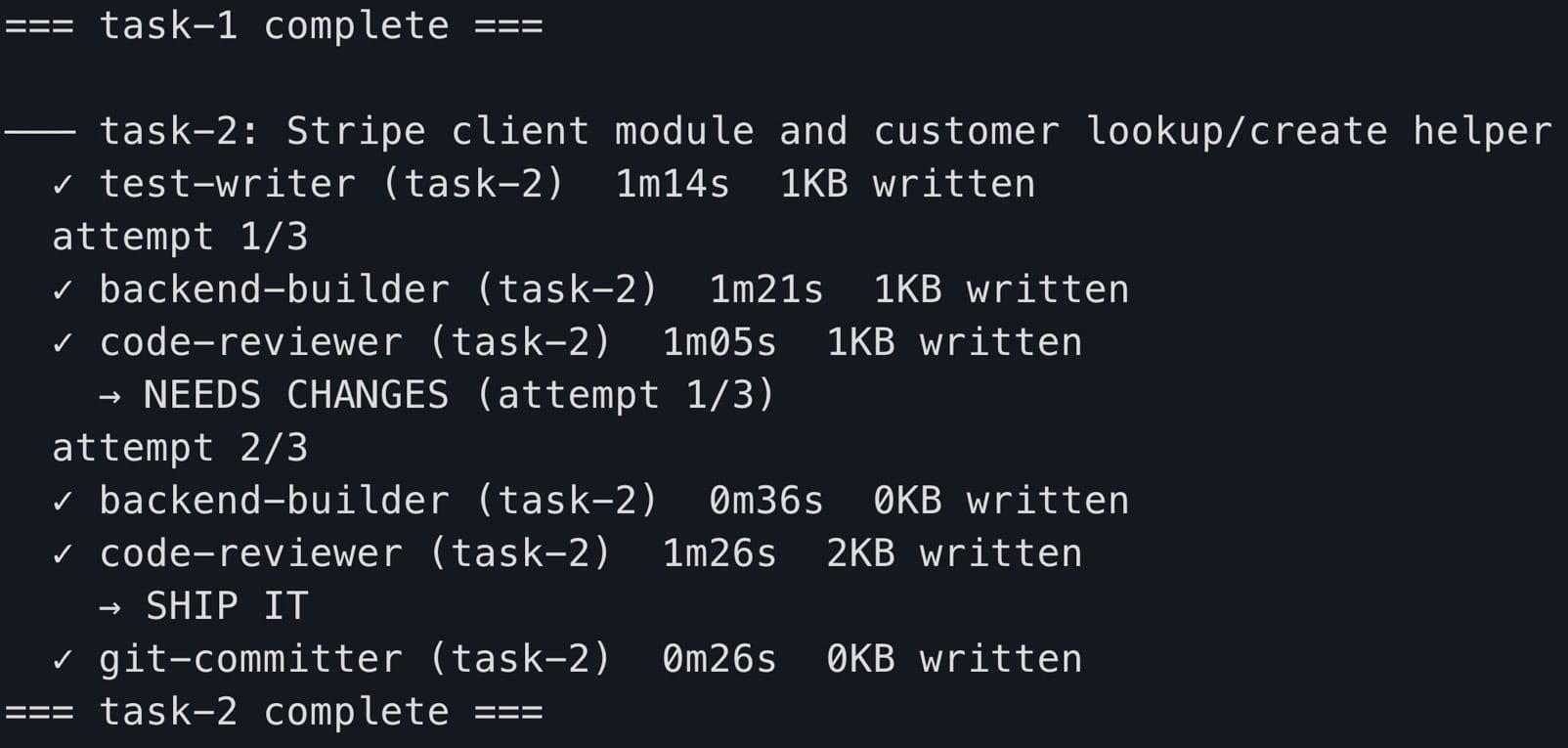
Note: that's a shell script running, which is neat but so last week. The new agent teams stuff from Anthropic handles all of this for you through some API calls. You can orchestrate individual Claude processes to get things done even faster.
It's a pretty straightforward process:
- I use my
product-designeragent to help me think through requirements, and then write them down in a PRD. - The
test-writeragent, using Sonnet 4.5, creates the tests using that PRD beforehand as a way for my frontend-builderandbackend-builderagents to write some code. These guys are dedicated and don't do any kind of testing or review; they just write the code.- My
code-reviewerthen goes off and does its thing, completely independent in terms of context. It only knows about the PRD, the tests, and the code for the task. If it doesn't like what it sees, it kicks off the build loop again. - If the
code-reviewergives aSHIP ITresponse, thepmagent kicks in and documents what was done for the sprint. Thegit-committerdoes its thing at that point, and we're off to the next task.
There's a lot more that goes on here. Each step is logged, as is each decision, so when things crash (which they do) the debugging step takes 20 seconds or so. The loop is impressive, but the debugging is insane.
That, to me, is the secret to all of this: write it down. If you know what you did and know what Claude did, it's pretty darn easy to troubleshoot.
I'm having fun with all of this, so what's the problem? Well, if you can't tell, I just replaced 4-5 people with a run loop.
And I trust the code from these agents more than I would from a group of humans. There, I said it: Claude writes code better than me, and probably you, too. It can do that because I know how to make it do that. I don't generate "AI slop", I generate beautiful, well-documented, well-tested code because I've taken the time to learn how.
These agents will work all night, all day, and into the next night, the next day, over the weekend, during holidays, and the full 6-7.
Want me to show your boss how I did this?
The Wolf
There's a scene in Pulp Fiction where Harvey Keitel shows up as Winston Wolf. "I'm Winston Wolf. I solve problems." He doesn't talk for long and he doesn't negotiate. He assesses the situation, gives clear instructions, and the mess is gone. Nobody asks how.

This is where we're at with AI adoption. Your boss (or maybe you) knows that AI is here, and a transition needs to be made. Your boss might care about you, sure, but business is business. Someone, somewhere, will show up one day and crash your party. Maybe that someone will be you, maybe a colleague, or maybe even me.
I'm getting two to three emails every week asking if I'm available for consulting. They want to know about agentic run loops and how to "improve operations." I always tell them the same thing:
I can absolutely help you, but one of two things will need to happen: the rest of your org or company catches up to you, or you scale back ... somehow.
Let's be clear about this: the easiest gain is to reduce headcount. "Scaling back" is a nice euphemism, but it means you and your job are now calculations in a spreadsheet. Let's be even more clear about this: what I charge for these gigs is a rounding error in terms of your salary and benefits. It's not really a decision for those that pay you.
Detroit Knows This Story
In the early 1980s, American automakers started bolting robotic arms onto assembly lines. Welders, painters, line workers, something like 300,000 of them were gone within four years. The UAW fought it. Politicians made promises; but the jobs left anyway, not because the robots were better at everything, but because they were better at enough things, and they didn't need health insurance or bathroom breaks or a pension.
.jpeg)
The auto industry didn't die. It just rearranged itself. The people who learned to program and maintain those robotic systems became the most valuable workers on the floor. They went from operating the machine to managing it. The ones who crossed their arms and said "this is robotic slop" got left behind. Not by malice, just by math.
We're in that moment again, except it's not welding arms on a factory floor. It's code in a run loop, and the transformation is moving a whole lot faster than it did in Michigan.
Replaced By a Loop? Or Nah?
As I write this, I can feel that some of you might have a reaction that goes like this:
Sad to see Conery join the AI grift. He's resorted to doom posting to get subs and signups. Another one bites the dust...
This is fair, but I honestly have nothing to sell you and I certainly don’t need any more work. My cohort is completely filled and my calendar is full of calls with bosses just like yours, looking to flex AI to their advantage. I do not need more work. I can barely keep track of the work I'm doing now.
Writing notes like this one takes time, and I hope you see it for what it is: me, sharing with you, what I'm seeing. Which is an opportunity for you to shift your career and become indispensible. You can learn what you need to know from free channels on YouTube, playing on your own, reading up on the docs, and having the time of your life. It truly is great fun!
Unfortunately that "great fun" part is balanced by a stark reality: you will get left behind if you ignore this stuff. If that happens, and you think "shoot why didn't anyone tell me this was happening so quickly", perhaps reflect on this note that landed in your inbox, or that you're reading online.
You're being sent a few boats and helicopter here (not from me, to be clear, but from somewhere). GET IN ONE OF THEM.
If you're an executive, lead, owner, founder, or boss of some kind and you're reading this, thinking about that email you've been meaning to send me: yes, I'll answer it, and yes, I can help you.
Yes, it's true: your company will move at a pace that you won't believe, and you'll deliver far, far faster than you ever thought possible. It's not just 10x, it's closer to 100x when you get everything dialed in, and it's a mere fraction of the cost.
I know this because I'm doing it for myself, right now, and I've done it for companies just like yours. Big ones, little ones, red ones, green ones. I use these tools every day, aside from this note, which I wrote by hand, because that's my promise, and that's what I do.
Thanks for reading, as always, and climb in that damned boat will ya!
Cheers,
Rob