The Lunchtime Prompt: Rip Out the Driver and Surprise Me
A complete course for developers who are serious about making AI part of how they actually work.
Before phase two I look at the context window, the little grid of squares in Claude Code that shows how many of the one million tokens Opus 5.5 gives me I've used. Empty squares are room to operate. A full context is noise, and the more noise the harder it is for Claude to work out what you want (if you like information theory, you're raising the entropy of the system). So I run the most important command in any AI programming tool, clear, and start fresh for a new branch and a new task. There's a whole section on token economics later.
I suspect Postgrex is still the only Postgres driver written in Elixir, but Elixir sits on Erlang and can use Erlang libraries, so I ask for a conversation first. The last sentence matters: with bypass permissions on, Claude will do things unless you tell it not to.
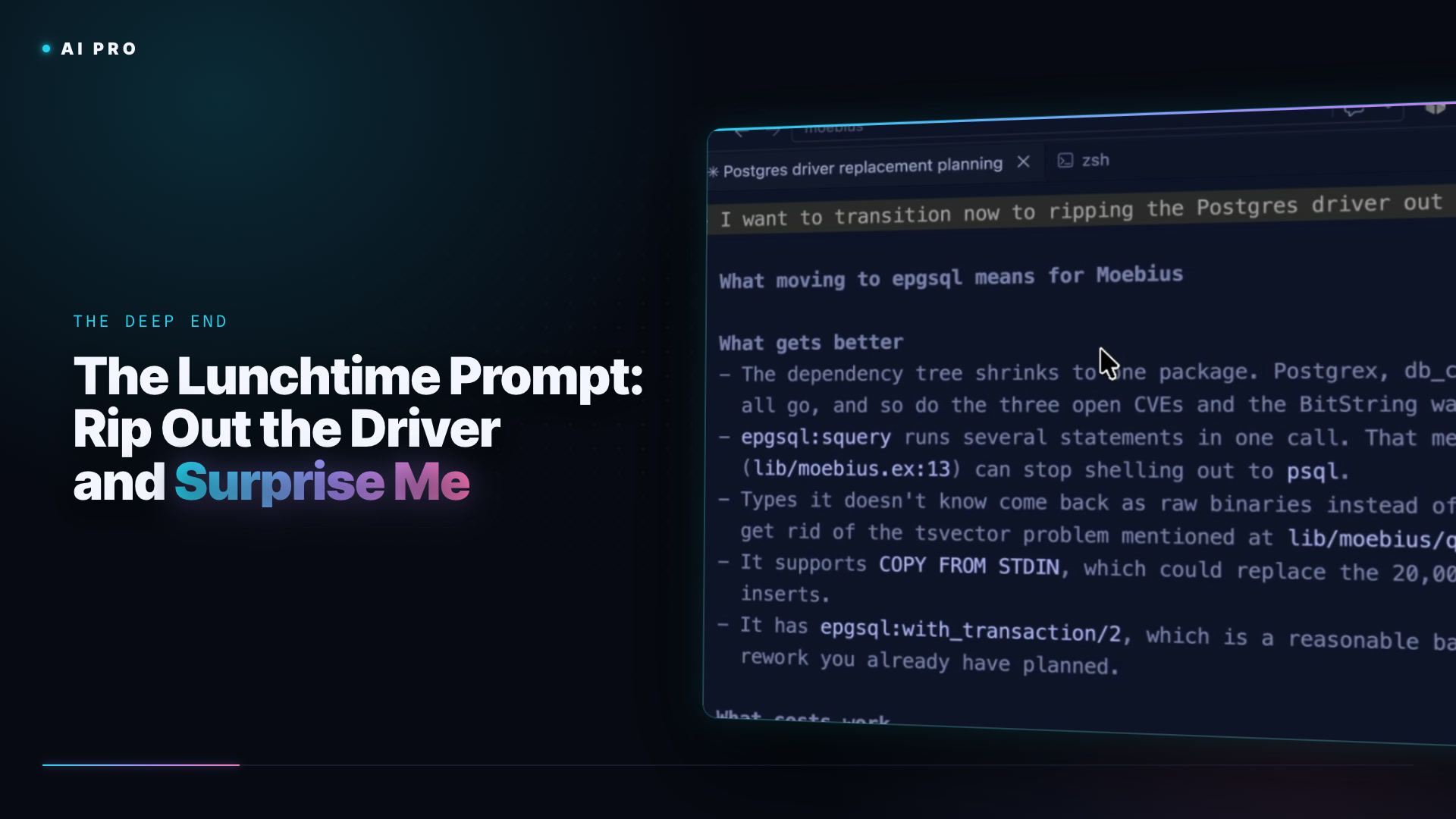
I want to transition now to ripping the Postgrex driver out, because I don't want to use it anymore. It has been, I believe, 11 years since it has been sub 1.0 and that has broken my versioning over the years. So I need to get rid of this and have a more stable dependency. So I want to go with an Erlang library and I know there's a few drivers out there. I know there's pgo and I think there's epgsql. Go and find out what other drivers are available and which one would fit my project the best. We're in planning mode here. We're not doing any actual work just yet. I want to have a discussion with you.
It checks Hex and GitHub and comes back with epgsql: 2.7 million downloads, a release in June 2025, a smaller dependency tree (goodbye telemetry). pgo is the same sub 1.0 problem I'm leaving, and the Gleam wrapper around it is dead. The cost is that epgsql has no connection pool, so we lean towards Pooler, and the public API change justifies bumping Moebius to 5.0. You could have Fable verify the research; I go with it. Claude suggests a small spike next. I don't want a spike, because then I have to review everything and the human time is the expensive part. I want the work done, tested and documented so I can review the result. This is the prompt that makes people think I'm nuts.
What I'd like for you to do is to make sure that all the branches are committed and merged into main. And then we're going to start work in a new branch here. I like the idea of epgsql. I like the idea of going with Pooler. And I think the whole swap out, I'm going to trust you with. However, before you do any of that, what I'd like for you to do is to go out and find some skills for how to implement best practices with Erlang and OTP, add them to the skills directory here. Also add some Postgres skills as well so that I can understand how to do high scale querying and how to manage Postgres properly with the SQL that I'm writing. I don't want to turn out trash. I want to turn out something wonderful. Finally, with the Elixir stuff, add some skills for solid testing and make sure that all of my tests and my code comply. Do that as a step one. And then step two, go ahead and rip out the entire driver, do all the work, add more tests to bump my confidence in what you're doing. And then surprise me, do something amazing. I want to see something outstanding and beautiful.
Why hand it all that at once? Because I can, and because Opus, Fable and models like Astra will blow your mind if you give them room to. Claude notices the prompt came in as pasted text (that's Wispr Flow), checks that I meant it, and asks me to resolve two conflicts: branches go in, phase one only, and keep it local for now. That back and forth is normal. Then I call this what it is, a lunchtime prompt, 15 to 30 minutes of it touching nearly everything, and we come back to see whether it amazes us.
A complete course for developers who are serious about making AI part of how they actually work.