Opus Didn't Get Dumb: A Peek Inside Claude Code's System Prompt
A complete course for developers who are serious about making AI part of how they actually work.
At some point you're going to scratch your head and wonder why Opus did something yesterday that it won't do today, or why Fable used to be so good. You'll see people on Twitter swearing the model got dumb. It didn't. It's almost always the tool, and more specifically it's the system prompt that Anthropic tweaks, adjusts and fine tunes underneath you. I had this happen the other day: Opus handed me some of the worst prose I've ever seen from it, and I knew exactly what had happened.
There's a weird optimization going on, too. As the frontier models get smarter they need less handholding, so Anthropic cut 80% of Claude Code's system prompt (according to them, with no performance loss). I didn't notice anything. A few people did.
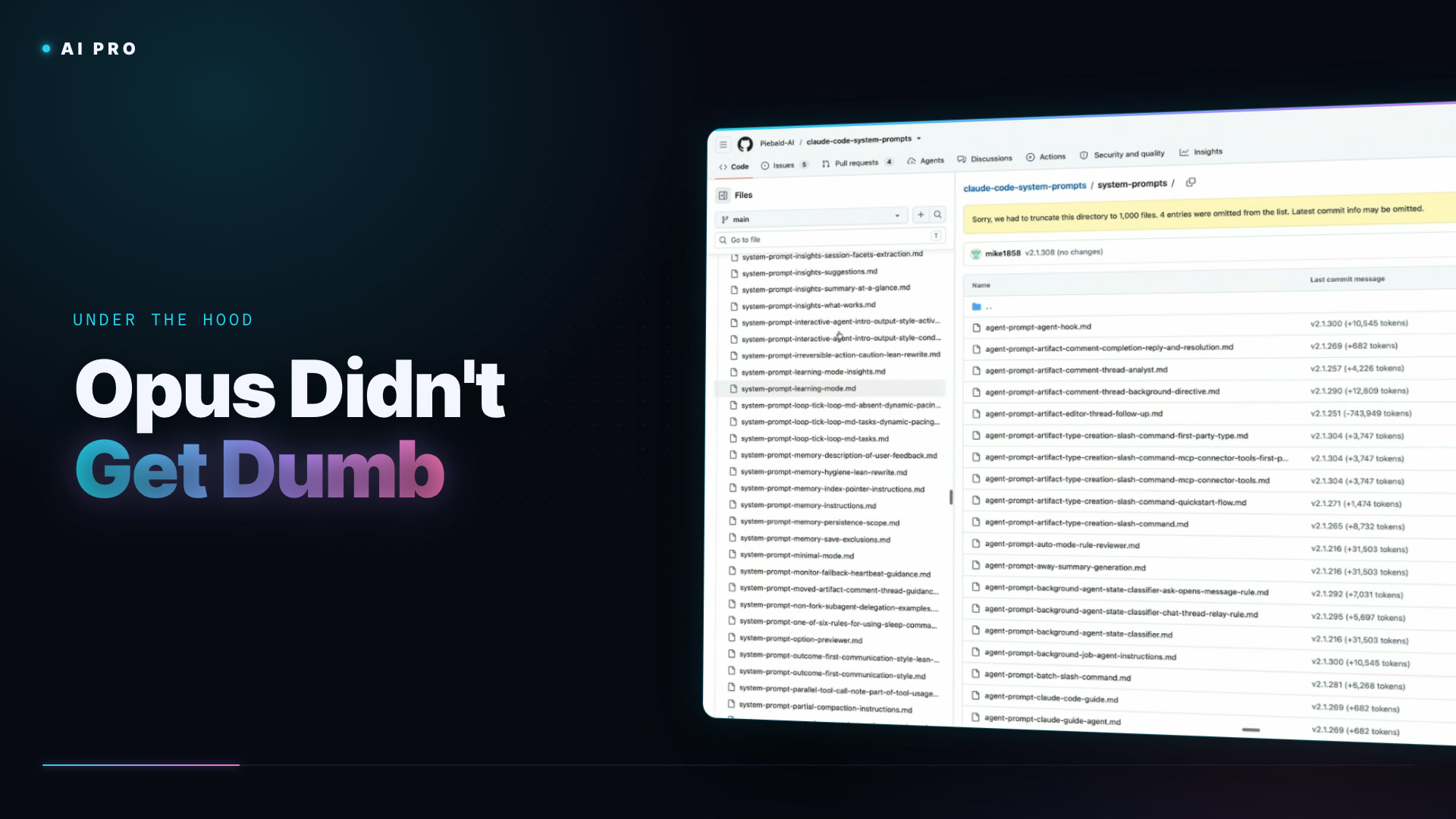
So what's actually in there? Claude Code's system prompt got put online a few months back, and the folks at Piebald AI loaded it up in a GitHub repo you can browse. It's huge, truncated to 1,000 files, and almost every file is a paragraph or two of instruction that gets loaded as needed. Claude wrote a lot of it, which is kind of fun. We poke around: identity, built-in tool descriptions, and my favorite, emoji avoidance, which explains why Claude Code won't hand you a rocket ship unless you ask for one. There's also a directive not to write code comments, and I think that's about saving tokens. Others think it's clean code. Put your tinfoil hat on if you like and we can argue about it.
When I wanted the high-level version I just asked Google, and that search is here if you want to run it yourself:
what are some things in claude code system prompt
If you don't like what you find in there (plenty of people don't), there are other tools out there like pi.dev and OpenCode. We'll get to those soon.
A complete course for developers who are serious about making AI part of how they actually work.